
Reviews
Part of How to judge copywriting services: scoring, quotes and compliance evidence
Comparing copywriting services products without a like-for-like trap
A practical product comparison method for copywriting services in England, with a scoring rubric, evidence rules and questions to ask before you shortlist.
What to take away
- A Manchester marketing team comparing three copywriting services products should score the same ten criteria for each, not the features each supplier chose to pitch.
- Weighting matters more than scoring. Decide what a missed deadline costs before you open a spreadsheet.
- Ask for deliverables, revision limits and named writers in writing, then check the claim against the contract.
- Treat regulatory fit as a pass or fail gate, not a score, because a non-compliant supplier cannot be rescued by a strong total.
Build the comparison around your brief
Most supplier comparisons fail because the buyer scores the sales deck. A better starting point is your own brief: the channels, the volume, the approval chain and the deadline that actually matters this quarter.
Brief-first comparison checklist
- Write the brief first
- List what each product must do
- Remove criteria you cannot justify
- Keep the list to ten criteria
- Include reporting and handover rights
Write the brief first, then list what each copywriting services product must do to satisfy it. If you cannot explain why a criterion is on the list, remove it. Our guide to copywriting services review methodology in England explains how to turn that brief into evidence you can audit later.
Keep the list to ten criteria. Longer lists get abandoned halfway through, and the abandoned half is usually the part about reporting and handover rights.
A scoring rubric you can reuse
Score each criterion from 1 to 5, then multiply by a weight. Style and tone quality usually deserve the heaviest weighting for brand-led work; turnaround and escalation matter more for newsroom-style output.
Weighted scoring rubric
Criterion
- Brief interpretation
- Restates objective and audience
- Sample quality
- Relevant to your sector
- Named writers
- Individuals identified, substitutes agreed
- Revision terms
- Rounds stated numerically
- Turnaround
- Committed days, escalation route
- Measurement
- Reporting on output and rework
- Rights and reuse
- Copyright assignment and licence
- Regulatory awareness
- Training on advertising and data rules
What good looks like
- Brief interpretation
- 3
- Sample quality
- 4
- Named writers
- 3
- Revision terms
- 3
- Turnaround
- 4
- Measurement
- 2
- Rights and reuse
- 3
- Regulatory awareness
- 4
Weight
- Brief interpretation
- Sample quality
- Named writers
- Revision terms
- Turnaround
- Measurement
- Rights and reuse
- Regulatory awareness
| Criterion | What good looks like | Weight |
|---|---|---|
| Brief interpretation | Restates your objective and audience without prompting | 3 |
| Sample quality | Relevant to your sector, not a generic portfolio piece | 4 |
| Named writers | Individuals identified, with substitutes agreed in writing | 3 |
| Revision terms | Rounds stated numerically, with a defined scope per round | 3 |
| Turnaround | Committed working days, plus a named escalation route | 4 |
| Measurement | Agreed reporting on output, cost per asset and rework rate | 2 |
| Rights and reuse | Full assignment of copyright and licence terms set out | 3 |
| Regulatory awareness | Evidence of training on advertising and data rules | 4 |
| Handover | Files, style guide and glossary transferred at exit | 2 |
| Price transparency | Rate card or day rate stated, with change control | 3 |
Multiply score by weight and total the column. A supplier scoring 4 on a weight of 4 beats one scoring 5 on a weight of 2, which is the point of weighting at all.
Where comparison quietly breaks down
Samples that are not comparable
A supplier may submit an award-winning long-form article against a competitor's rushed product page. Ask every supplier for the same three asset types, drawn from the last twelve months.
Where a claim is about accuracy or compliance, test it against a published source, not the supplier's own summary. The ICO's UK GDPR guidance and resources sets out lawful handling of personal data in briefs and customer research.
The work the ASA and CAP do covers monitoring and enforcement, the standard your published claims will be judged against.
Prices quoted on different bases
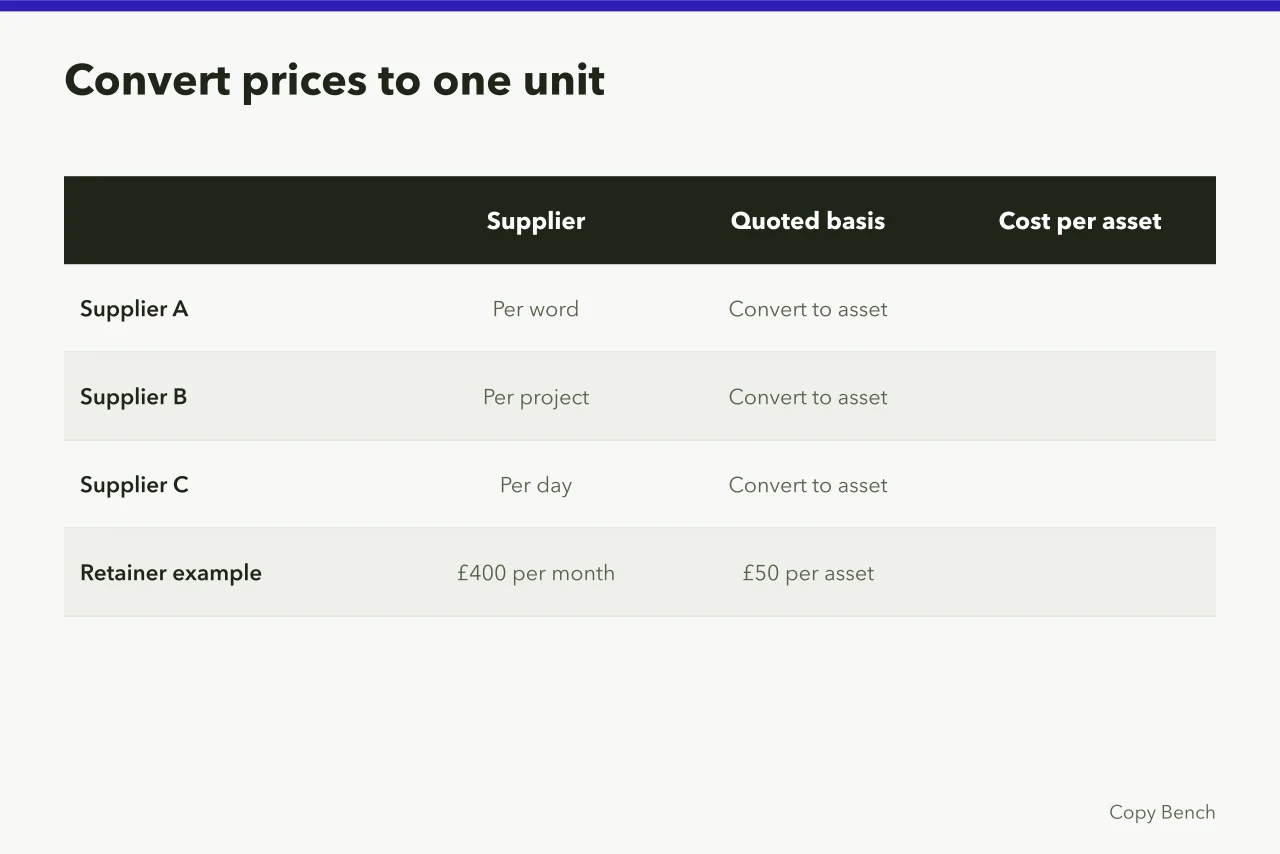
One supplier quotes per word, another per project, a third per day. Convert everything to a single unit, such as cost per finished asset at your expected volume. For example, a team paying £400 a month for a retainer that produces eight assets is paying £50 per asset, whether or not the invoice says so.
Capability claims with no evidence
Planning frameworks and content strategy skills are worth scoring, but ask how they were built. Training providers such as CIM's strategy and planning courses publish their syllabus, so you can compare claimed capability against a documented curriculum rather than a testimonial.
Set a gate before the total score
Some criteria should disqualify rather than deduct. If a supplier cannot confirm who owns the copyright, or cannot describe how they handle personal data in customer interviews, the total score is irrelevant.
Run the gate first. Then rank the survivors. Our pillar guide to copywriting services reviews and comparison methods sets out the wider framework this rubric sits inside, including how to document decisions so a colleague can pick them up later.
Record the gate outcome next to the score, with the date and the evidence you saw. A comparison you cannot reconstruct in six months is a comparison you will run again from scratch.
Common questions
How many suppliers should I compare?
Three to five is workable. Fewer gives you no real choice, and more than five usually means the later submissions get less scrutiny than the earlier ones.
Should price carry the heaviest weight?
Rarely. Price matters, but rework and missed deadlines usually cost more than the difference between two credible quotes, so weight turnaround and revision terms first.
What evidence should sit behind a score?
A document, a dated email or a named sample. If the only evidence is a verbal assurance on a call, score it lower until it is confirmed in writing.
Can I reuse the same rubric next year?
Yes, and you should. Keep the criteria stable and change the weights to reflect the coming year's priorities, so scores stay comparable across buying rounds.