
Outlook
Part of How to build a copywriting services outlook as AI and data rules shift
Copywriting services risk scenarios without the guesswork
A guide to copywriting services risk scenarios for England teams, covering client-side, supply-side and regulatory triggers with a scoring rubric and review dates.
What to take away
- A copywriting services risk scenario is a named, dated event with a trigger you can watch, not a vague worry about content quality.
- The three scenario families that matter most to England providers are client-side demand shocks, supply-side capacity failures and regulatory action on claims.
- Score each scenario on likelihood and impact, then set a review date tied to a real event such as an ad campaign launch or a contract renewal.
- Regulatory scenarios carry the highest impact because the Digital Markets, Competition and Consumers Act 2024 (Part 4, Chapter 1), which replaced the Consumer Protection from Unfair Trading Regulations 2008, allows enforcement against misleading marketing claims, and the CAP Code adds advertising-specific duties.
- Keep the register to six scenarios so it stays a working document rather than a filing exercise.
Client-side risk scenarios
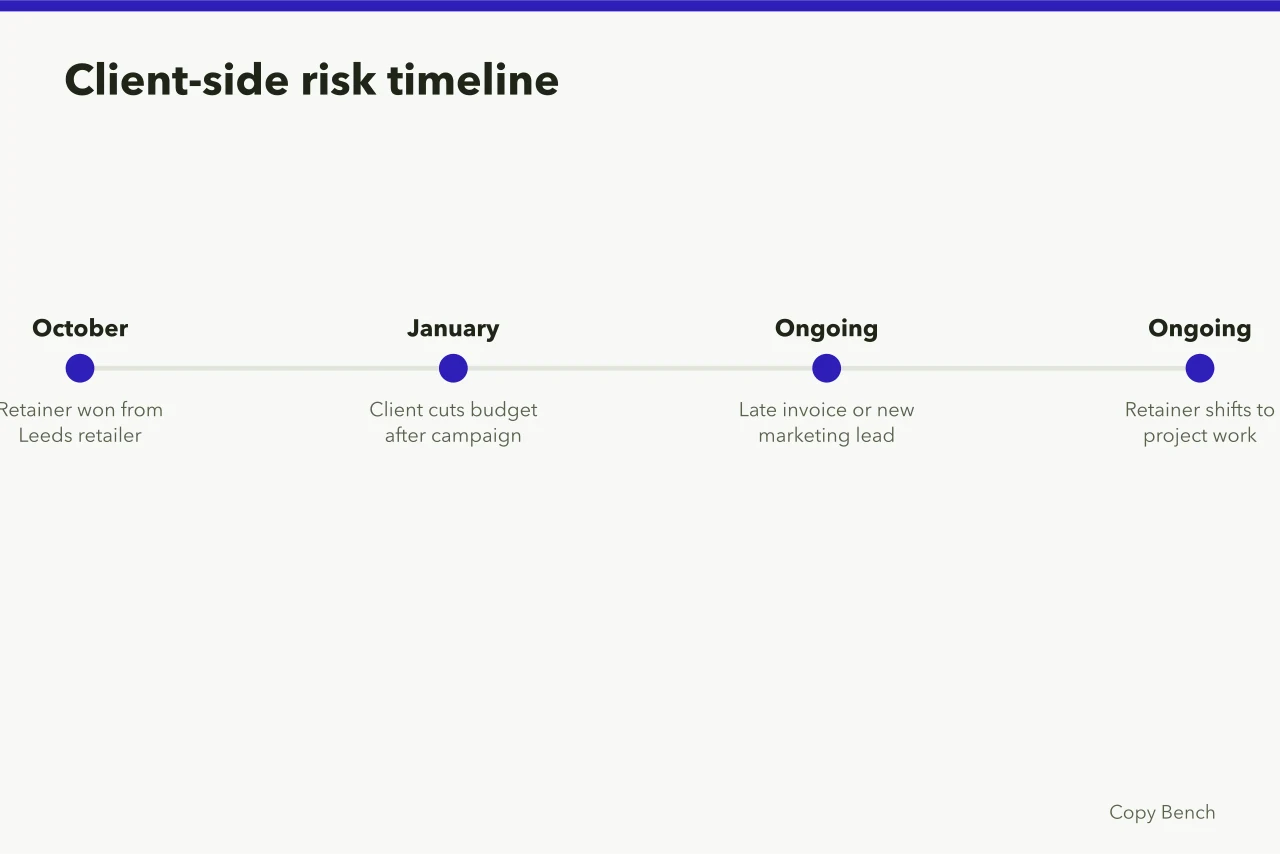
Picture a Leeds agency that wins a retainer from a local retailer in October, then watches the client cut the budget in January because a seasonal campaign underperformed. That is a client-side scenario, and it is the most common one for copywriting services providers in England.
Retainer loss impact
- £6,000Monthly billing across four clients
- £1,500Account lost
- 4Clients affected by one loss
Demand shocks from client budgets
A demand shock arrives when a client pauses, cuts or redirects spend. Watch for three signals: a late invoice, a new marketing director, or a shift from retainer work to project work. Each signal gives you weeks of warning if you log it.
For a worked example, an agency billing £6,000 a month across four clients loses one £1,500 account and must decide whether to reduce freelance hours or absorb the cost. The scenario is the loss, not the decision.
Brief quality and approval delays
Poor briefs and slow approvals are a quieter risk. They do not stop revenue immediately, but they push delivery dates and erode margin. Track the gap between brief received and brief approved for each client.
When that gap doubles, treat it as a trigger. The fix is usually a written brief template and a named approver, not more copywriters. For the broader market picture behind these patterns, see Copywriting services: trends and outlook for England in 2027.
Supply-side risk scenarios
Capacity risk gets less attention than demand risk, yet it can be more damaging because it affects every client at once. A single senior writer leaving can stall a pipeline for weeks.
Key person dependency
If one writer holds the tone of voice for three accounts, that person is a single point of failure. Score this scenario high on impact and moderate on likelihood. Mitigate it with documented style guides and a second writer who has delivered at least one piece per account.
Freelance availability and rate shifts
Freelance rates move with demand. A rise of 10 per cent on a £3,000 monthly freelance bill adds £300, which is enough to wipe out margin on a small retainer. Watch rate changes quarterly and agree notice periods in writing.
SME demand also shifts where clients move budget into paid social. LinkedIn's own guidance on small business advertising shows how quickly a client can reallocate spend away from long-form content. Read LinkedIn's small business advertising guidance alongside your own client mix to judge how exposed you are.
Regulatory and compliance scenarios
Regulatory scenarios are rare but expensive. They also tend to arrive without warning, which is why they belong in the register even when likelihood looks low.
Misleading claims in client copy
A claim that a product is "the best" or "guaranteed" can breach the consumer protection rules in Part 4, Chapter 1 of the Digital Markets, Competition and Consumers Act 2024 if it misleads the average consumer. That Act, which replaced the Consumer Protection from Unfair Trading Regulations 2008, sets out the misleading and aggressive practices that trigger enforcement.
Put a claims checklist in every brief. Flag superlatives, health claims and price comparisons for client sign-off before publication.
Advertising code breaches
The CAP Code applies to ads and marketing communications, and the ASA publishes guidance for businesses on how to comply. Use the ASA advice for businesses when a client asks whether a comparison or testimonial is acceptable.
If your client base is drifting toward regulated sectors, Copywriting services 2027 trends in England sets out which categories are growing and where compliance pressure is rising.
Scoring rubric
Score each scenario from 1 to 5 on likelihood and impact, then multiply. Review anything scoring 12 or above every quarter.
| Scenario | Likelihood (1-5) | Impact (1-5) | Score | Trigger to watch |
|---|---|---|---|---|
| Client pauses retainer | 4 | 4 | 16 | Late invoice or new marketing lead |
| Brief approval gap doubles | 3 | 3 | 9 | Days from brief to sign-off |
| Key writer leaves | 2 | 5 | 10 | Notice period served |
| Freelance rates rise 10% | 3 | 3 | 9 | Quarterly rate review |
| ASA or CMA complaint | 1 | 5 | 5 | Claims flagged in review |
| Client moves budget to paid social | 4 | 3 | 12 | Channel spend shift |
Common questions
What is a copywriting services risk scenario?
It is a defined event that could disrupt delivery, revenue or compliance, written as a trigger plus an impact. Naming the trigger lets you act before the event lands.
How often should the register be reviewed?
Quarterly is enough for most England providers. Add an ad hoc review whenever a client changes marketing lead or a contract comes up for renewal.
Which scenario should a small team watch first?
Client concentration. If one account is more than a third of revenue, a single pause can force immediate cost decisions.
Do regulatory scenarios apply to small providers?
Yes. The Digital Markets, Competition and Consumers Act 2024 and the CAP Code apply regardless of team size, so claims checks belong in every brief.